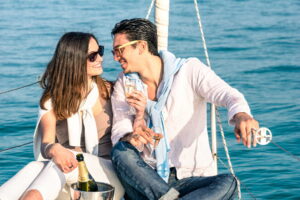
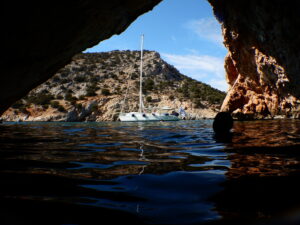
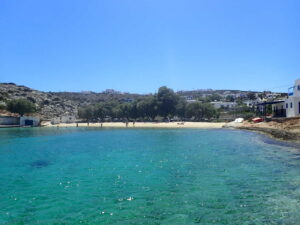
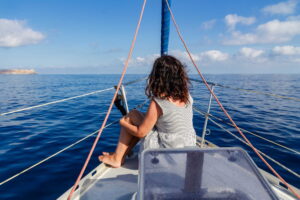
There is a specific moment during a sailing day in the Cyclades when everything changes. The engine quiets. The boat drifts instead of pushing forward. The color of the sea deepens from bright turquoise to a heavier, calmer blue. What had felt like a destination suddenly becomes a state of mind. This moment almost never happens on a well-known beach. It happens in a remote bay, usually one without a name, without signs, without any trace of organized activity. These places are not hidden intentionally. They are simply beyond the reach of roads and schedules. And that distance is exactly what preserves them.
In the Cyclades, access defines experience. What is easy to reach becomes busy. What requires sailing remains quiet.
Why remote bays feel different
A remote beach does not offer convenience. There are no umbrellas, no cafés, no background noise. Reaching it usually means arriving by boat, guided by the weather forecast, the shape of the coastline, and the daily rhythm of wind and waves. This natural barrier filters crowds more effectively than any rule or restriction. Because these bays are often protected by rock formations or landmass, the sea inside them behaves differently. Waves soften. The water settles. Swimming becomes effortless rather than cautious, and diving visibility improves dramatically because sediment is not constantly stirred.
Silence becomes the dominant element. Not silence as emptiness, but silence as space. Space to float without effort. Space to hear water moving against rock. Space to slow down without feeling that time is being wasted.
For many travelers, this is the first moment the Cyclades stop feeling like a postcard and start feeling personal.
Sailing as access, not transport
Arriving at a remote bay by sailboat changes behavior immediately. There is no rush to secure a spot or set up equipment. You anchor, observe, and enter the water when it feels right. Leaving is just as unforced. The island tour adapts to the people on board, not the other way around.
This fluidity is not accidental. Routes are chosen based on real conditions, not assumptions. Experienced skippers read the forecast, understand how wind interacts with island geography, and select bays where comfort and clarity are prioritized. Even on days when the wider Aegean feels unsettled, these sheltered areas remain calm and welcoming.
Because nothing competes visually for attention, these places also offer exceptional conditions for photos and videos. Light reflects upward from the seabed. Colors remain clean. The absence of crowds allows images to feel natural instead of staged. Remote bays rarely impress loudly. They impress quietly· and that impression lasts.
Why people remember these places
Most guests do not remember how many bays they visited. They remember how one of them felt. They remember floating without thinking, how clear the water was, how little effort the day required. This is why remote bays often become the emotional center of a sailing day. Not because something dramatic happened, but because nothing interrupted the experience. No noise. No pressure to consume. No need to move on quickly.
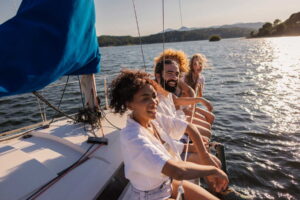
These moments suit everyone. Families feel safe. Mixed groups relax into the space. Women traveling together often remark on how comfortable the environment feels. Participation is optional. Some swim constantly. Others stay on deck. All feel included. And from a practical perspective, these experiences make sense. Sailing to remote bays often replaces multiple land-based expenses with one coherent ticket. Ferry costs, transport, rented equipment, and time lost between locations disappear. What remains is a single price that delivers access, comfort, and depth.
In that sense, remote bays are not a luxury. They are an economic use of time and money. Especially for a group, the experience becomes surprisingly affordable, sometimes even cheap when compared to fragmented alternatives.
Where the Cyclades reveal themselves
The Cyclades are famous for light, color, and water. But they are defined by something quieter: rhythm. Remote bays are where that rhythm becomes visible. Or rather, tangible. This is where the islands stop performing and where they simply exist.
And when experienced from the sea, without interruption, without hurry, that simplicity becomes the most powerful memory of all.