The Aegean Sea has a reputation. It is often described as wild, windy, unpredictable. For first-time visitors to the Cyclades, this reputation can sound intimidating, especially when planning a sailing or yachting experience. Yet those who spend real time at sea here quickly discover something different. The Aegean is not chaotic. It is patterned. And when those patterns are understood, the sea becomes not a risk, but a guide.
Great sailing days in the Cyclades are rarely the result of perfect conditions. They are the result of correct interpretation.
Weather as information, not limitation
Most travelers check the weather forecast hoping to see one thing: calm. Experienced skippers look for something else entirely. They look for direction, duration, and interaction. Wind speed alone means very little without context. What matters is how that wind moves across islands, how landmass interrupts it, and where waves are allowed to build· or are quietly broken apart.
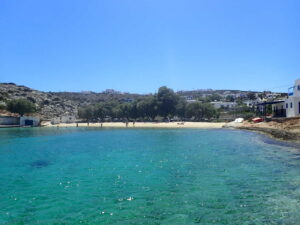
In the Cyclades, islands are close together. This creates natural sea corridors where water remains surprisingly smooth even when wind is present elsewhere. A forecast that appears unfavorable on a generic app often translates, in practice, into a perfectly comfortable day· simply on a different route. This is why sailing days are rarely cancelled. They are redesigned. Northern winds suggest southern coastlines. Stronger breeze encourages routes closer to land. Sheltered bays and remote bays offer protection, clarity, and calm anchorage. The sea does not disappear; it cooperates differently.
The role of geography
Geography does most of the work long before the sails are raised. Island size, orientation, and distance determine how the Aegean behaves. Larger islands interrupt wave energy. Long coastlines soften wind impact. Narrow passages create controlled flow rather than open exposure.
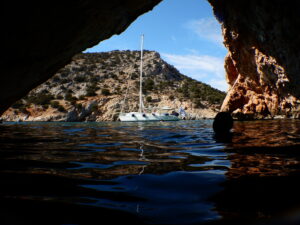
This is where Naxos plays a crucial role. Its size and position create natural shelter, particularly along its southern and southwestern sides. Even on days when the wider Cyclades feel restless, these areas remain accessible, calm, and ideal for swimming and light diving. For guests, this means predictability without rigidity. A sailing day does not depend on luck. It depends on knowledge.
Comfort, safety, and experience
Understanding the Aegean’s behavior directly affects comfort on board. Reduced wave action makes movement easier, entry into the water safer, and time at anchor more enjoyable. Swimming feels relaxed rather than cautious. Water sports remain playful rather than demanding.
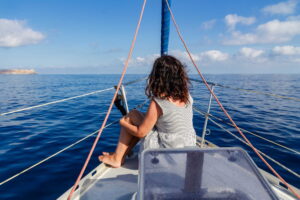
This matters especially for mixed groups, families, and women travelers, who often value stability and comfort over spectacle. It also matters for those capturing photos and videos, as calmer water and steady light produce cleaner, more natural results. From a safety perspective, the same principles apply. Predictable conditions reduce fatigue, stress, and unnecessary risk. Professional skippers are not reacting to the sea; they are anticipating it.
Why flexibility creates value
One of the least visible but most important benefits of experienced sailing is flexibility. A day at sea with Annabella is not tied to a single destination. If one area becomes less comfortable, another opens. The island tour adapts without disruption.
This flexibility protects value. Guests still experience remote beaches, quiet bays, and clear water even when conditions shift. Time is not lost. Expectations are not broken.
From a financial perspective, this reliability matters. When travelers invest money in a sailing ticket, they are paying not only for the boat, but for interpretation, judgement, and calm decision-making. That invisible expertise is what turns uncertainty into consistency. And consistency is what makes a price feel fair, a cost feel justified, and an experience feel affordable rather than risky.
The quiet influence of the sea
At the end of the day, guests rarely talk about wind speed or wave height. They talk about how the day felt. How easy it was to move. How clear the water was. How unhurried the experience seemed.
That ease is not accidental. It is the result of reading the Aegean correctly· of understanding that the sea does not need to be controlled, only respected.
A great sailing day in the Cyclades is shaped quietly. By geography, experience and by decisions made before guests even notice them. And when weather and waves are read rather than resisted, the Aegean reveals itself not as something to fear, but as something to trust.